
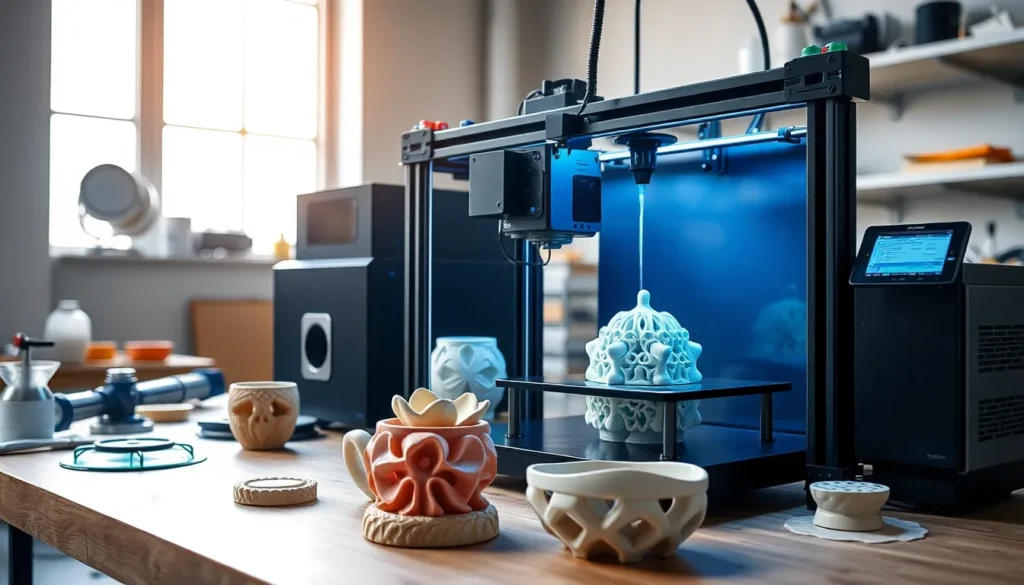
Ceramic 3D printing is revolutionizing the way industries approach design and manufacturing. This innovative technology allows for the creation of intricate and customized ceramic objects, pushing the boundaries of traditional methods. With its ability to produce complex geometries and reduce material waste, ceramic 3D printing is gaining traction across various sectors, from art to aerospace.
As the demand for sustainable and efficient production methods grows, ceramic 3D printing stands out as a game-changer. It combines the aesthetic appeal of ceramics with the precision of additive manufacturing, making it an attractive option for designers and engineers alike. Whether it’s creating unique art pieces or functional components, this technology is opening new doors for creativity and efficiency in the ceramics industry.
Overview of Ceramic 3D Printing
Ceramic 3D printing revolutionizes the production of ceramic objects by using advanced additive manufacturing techniques. This technology allows for the creation of detailed and customized pieces, achieving levels of intricacy that traditional methods often cannot match.
Ceramic 3D printing employs various processes, including binder jetting, material extrusion, and stereolithography. Each method delivers unique advantages, such as speed, precision, and the ability to use a variety of ceramic materials. Binder jetting uses a liquid binder to fuse ceramic powder, creating solid objects. Material extrusion involves extruding a ceramic paste through a nozzle, forming shapes layer by layer. Stereolithography utilizes UV light to cure liquid resin into solid forms, offering high resolution.
The applications for ceramic 3D printing are diverse, spanning industries like art, architecture, healthcare, and aerospace. In the art sector, artists craft intricate sculptures that showcase the medium’s aesthetic properties. In healthcare, custom dental implants and surgical models enhance patient-specific treatments. Aerospace companies use lightweight ceramic components to improve fuel efficiency and performance.
Sustainability plays a significant role in the increasing popularity of ceramic 3D printing. This process minimizes material waste compared to traditional subtraction methods, as only the required amount of material is used. Furthermore, ceramics often possess eco-friendly properties, reinforcing their appeal in environmentally conscious production.
The fusion of aesthetic appeal and precision in ceramic 3D printing supports designers and engineers in both artistic and functional applications. Through continuous advancements, this technology is expected to redefine the boundaries of ceramic manufacturing.
Advantages of Ceramic 3D Printing
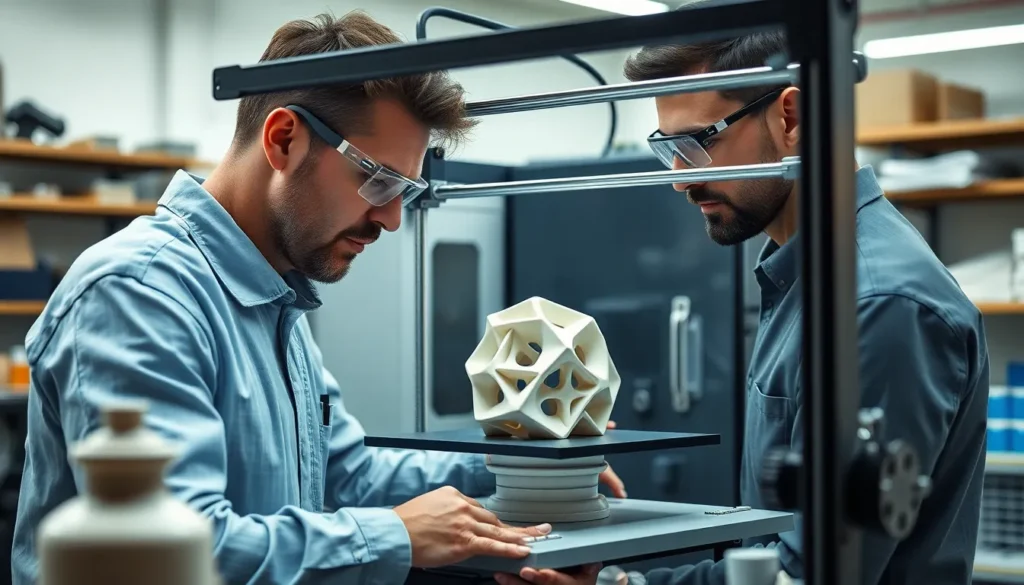
Ceramic 3D printing offers significant benefits that enhance its application across various industries. These advantages include enhanced design flexibility and improved material properties.
Enhanced Design Flexibility
Enhanced design flexibility stems from ceramic 3D printing’s ability to create intricate geometries and complex shapes. This technology allows for the production of customized objects that traditional manufacturing methods often can’t achieve. Designers can experiment with new forms, optimizing structural integrity and aesthetic appeal simultaneously. The layer-by-layer approach enables the incorporation of varying densities and materials within a single piece, fostering innovation in product development. Industries like architecture and healthcare leverage this flexibility to design unique components, from artistic sculptures to custom dental implants, highlighting the limitless potential of ceramic 3D printing.
Improved Material Properties
Improved material properties contribute to the growing adoption of ceramic 3D printing. The ceramics produced through this method often exhibit superior strength, thermal stability, and chemical resistance. These enhanced properties increase durability and longevity in applications such as aerospace and automotive, where high-performance materials are critical. Additionally, specific ceramic formulations can be tailored to meet unique requirements, ensuring optimal functionality for diverse applications. As a result, products like lightweight components benefit from ceramic 3D printing’s enhanced material characteristics, providing both structural advantages and cost-effectiveness in manufacturing processes.
Applications of Ceramic 3D Printing
Ceramic 3D printing finds use in various fields, driven by its ability to create customized solutions. The technology is reshaping industries such as healthcare and manufacturing with its precision and design capabilities.
Medical Applications
Ceramic 3D printing plays a crucial role in the medical field. It allows for the production of bespoke dental implants, customized orthopedic devices, and complex surgical tools. For example, bioceramic materials are used to create implants that promote bone integration, enhancing patient outcomes. Additionally, the capability to manufacture intricate anatomical models aids surgeons in preoperative planning, improving surgical precision.
Industrial Applications
Ceramic 3D printing also impacts various industrial sectors by enabling the production of lightweight components and complex tooling. Industries such as aerospace benefit from the creation of heat-resistant parts that reduce weight and improve fuel efficiency. Custom jigs and fixtures, often produced for manufacturing processes, enhance operational efficiency. The process’s ability to fabricate geometrically complex components leads to reduced lead times and material waste, making it an attractive option for modern manufacturing needs.
Challenges in Ceramic 3D Printing
Ceramic 3D printing, despite its notable advancements, faces several challenges that can hinder its widespread adoption and optimization.
Material Limitations
Material limitations pose significant challenges in ceramic 3D printing. Commonly used ceramic materials often exhibit brittleness, which can lead to cracking during the printing and post-processing phases. This brittleness restricts the design of thin-walled structures, as well as intricate shapes that require precise mechanical integrity. Additionally, there’s a limited variety of commercially available ceramic powders, which constrains innovation. Factors such as particle size, morphology, and moisture content can also affect the final product’s quality, necessitating strict control measures throughout the fabrication process.
Technology Constraints
Technology constraints hamper the performance of ceramic 3D printing. Current printing techniques often require prolonged sintering times, which extend production cycles. Some methods may not achieve the desired resolution, resulting in surface finish issues and dimensional inaccuracies. Thermal management during printing is crucial, as rapid temperature changes can induce warping or defects in the final product. Furthermore, existing software solutions for design and simulation may lack the capability to fully capture the unique behaviors of ceramic materials, complicating the design phase. Overall, these constraints highlight the need for ongoing research and development to enhance the efficiency and effectiveness of ceramic 3D printing technologies.
Future Trends in Ceramic 3D Printing
Ceramic 3D printing is poised for rapid advancements driven by technological innovations and market demands. Increased research efforts aim to develop new ceramic materials, enhancing performance characteristics and expanding application possibilities.
- Material Development
- Bioceramics are gaining traction in medical applications. These materials promote bone integration and improve patient outcomes in dental implants and orthopedic devices.
- Composite ceramics are emerging, combining ceramics with polymers or metals. This approach enhances durability and expands design options.
- Advanced formulations are under exploration to reduce brittleness, increasing the viability of intricate designs with thinner walls.
- Process Optimization
- Improved additive manufacturing techniques, such as digital light processing (DLP), are being refined for better resolution and surface finish. These innovations promise finer details in printed objects.
- Automation in post-processing is being integrated, minimizing manual labor and speeding up production times. This results in increased efficiency and reduced costs.
- Sintering processes are expected to evolve, with reduced timeframes and energy requirements. This advancement can enhance productivity in ceramics manufacturing.
- Sustainability Initiatives
- Eco-friendly materials are being developed, aligning with global sustainability goals. Manufacturers focus on recyclable and biodegradable ceramics for environmentally conscious production.
- Waste reduction strategies are being implemented, including optimized printing techniques that minimize excess materials and energy consumption.
- Industry collaboration is increasing, fostering the sharing of best practices for sustainable production within ceramic 3D printing.
- Broader Applications
- Aerospace and automotive sectors are set to benefit from more complex, lightweight components. Increased demand for fuel efficiency drives innovation in ceramic materials and designs.
- The integration of smart technologies is anticipated. Consequently, printed ceramics may incorporate sensors or electronics, leading to intelligent, multifunctional components in various applications.
- The art and design community will continue to explore ceramic 3D printing for artistic expression. Customizable designs and intricate shapes will push creative boundaries in ceramics.
- Market Growth
- The ceramic 3D printing market is expected to expand significantly, driven by rising demand from various sectors. Analysts project a compound annual growth rate (CAGR) of over 20% in the next five years.
- Increased investment from key players in research and development is anticipated. Competitive pressures will spur rapid innovation and commercial applications.
- Emerging markets in Asia-Pacific are showing heightened interest, providing opportunities for growth and adoption of ceramic 3D printing technologies.
These trends indicate a dynamic future for ceramic 3D printing, promising new possibilities in design, functionality, and sustainability across multiple industries.
Ceramic 3D printing is revolutionizing how industries approach design and manufacturing. Its ability to create intricate and customized objects while minimizing waste makes it a frontrunner in sustainable production. As advancements continue to emerge, the technology’s potential expands, opening doors to innovative applications in art, healthcare, and aerospace.
Challenges remain but ongoing research is addressing material limitations and process constraints. The future looks promising with new materials and improved techniques on the horizon. As the market grows, ceramic 3D printing will likely play a crucial role in shaping the future of manufacturing, combining aesthetic appeal with high performance. This technology is set to redefine possibilities across various sectors, making it an exciting area to watch.


