
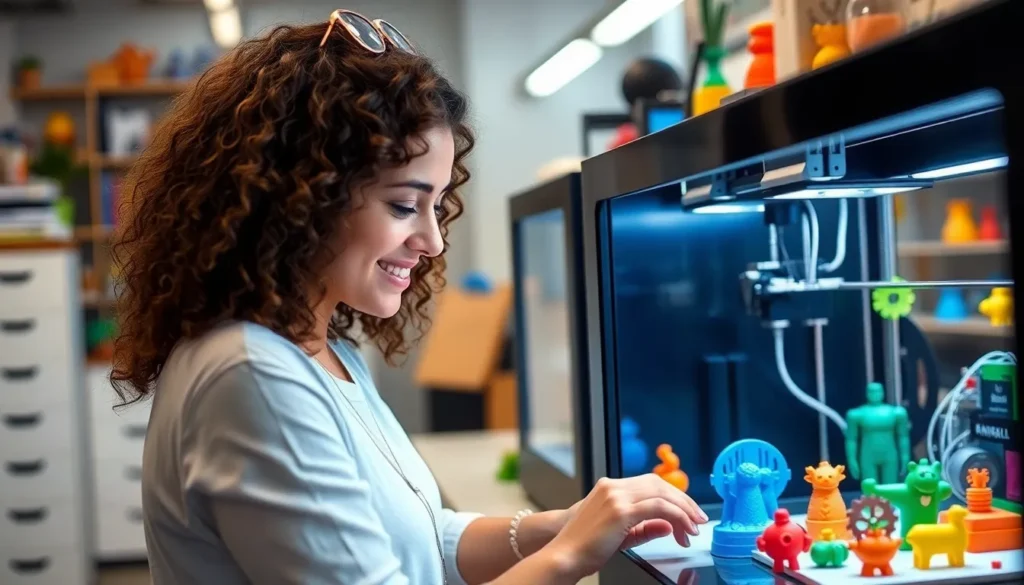
In a world where creativity meets technology, 3D printing is the magic wand turning dreams into reality. Imagine a printer that doesn’t just spit out paper but creates everything from toys to prosthetics. It’s like having a mini factory right on your desk, minus the hard hats and safety goggles.
This revolutionary technology is reshaping industries, sparking innovation, and making DIY enthusiasts feel like wizards. Whether it’s crafting a custom phone case or building intricate models, 3D printing opens up a universe of possibilities. So buckle up as we dive into the fascinating realm of D printing, where imagination knows no bounds and the only limit is your creativity.
Overview of D Printing
3D printing, also known as additive manufacturing, uses computer-generated designs to produce three-dimensional objects. Various materials, including plastic, metal, and resin, serve as the base, allowing for diverse applications. The process involves layering material until the final product is complete, showcasing intricate designs and high levels of customization.
Users can create items that were previously difficult or impossible to manufacture with traditional methods. Industries like healthcare utilize 3D printing for prosthetics, enabling tailored solutions for individual patients. Automotive manufacturers streamline prototyping, reducing time and costs significantly.
Educational institutions integrate 3D printing into curriculums, encouraging hands-on learning and fostering innovation. Hobbyists frequently engage in creating personalized gifts or home décor, showcasing creativity and technical skills. Moreover, sustainable practices emerge, with recycling materials now a viable option for some printers.
The affordability of 3D printers increases their accessibility, attracting both novices and experts. Trends indicate a growing presence in sectors like aerospace and construction, demonstrating flexibility and versatility. Advances in technology lead to improved printing accuracy and speed, enhancing overall product quality.
D printing’s potential disrupts traditional manufacturing methods, offering efficiencies that benefit various industries. As this technology evolves, it significantly impacts production processes, making it essential for users to stay informed about the latest developments.
Types of D Printing Technologies
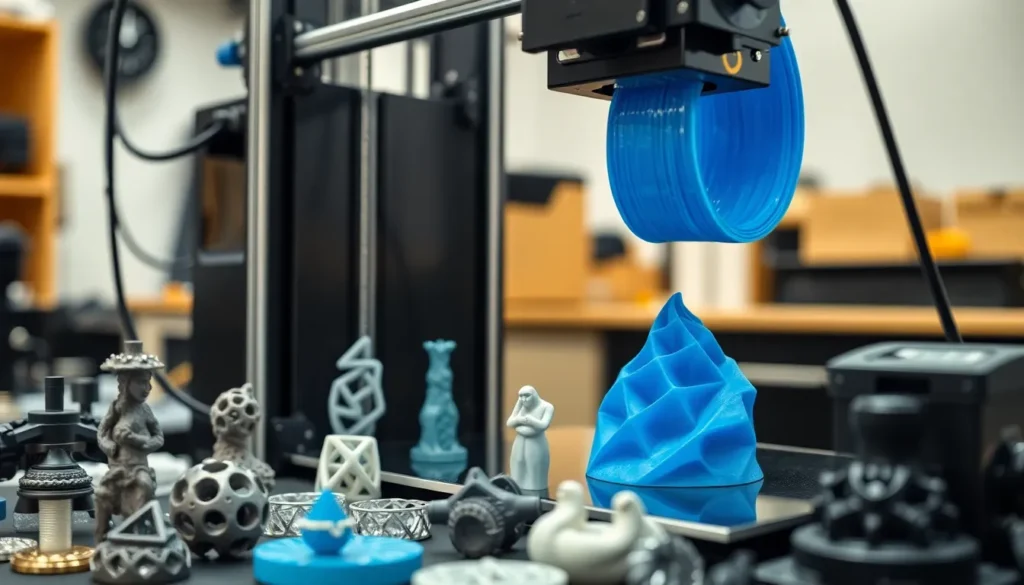
D printing encompasses various technologies, each offering distinct advantages and applications. Understanding these methods helps in selecting the most suitable one for specific projects.
Fused Deposition Modeling (FDM)
Fused Deposition Modeling remains the most widely used D printing technology. It involves extruding melted thermoplastic filament layer by layer to form an object. Users appreciate its affordability and ease of use, making it ideal for home projects and prototypes. Materials like PLA and ABS are commonly used, providing a range of options for strength and flexibility. Cost-effectiveness facilitates the creation of functional prototypes and small batch productions.
Stereolithography (SLA)
Stereolithography utilizes ultraviolet light to cure liquid resin into solid layers. This technology produces highly detailed parts with smooth finishes, attracting users who prioritize precision. Industries like jewelry and dental often employ SLA for intricate designs and models. A variety of resins are available, offering different characteristics like rigidity and transparency. SLA’s speed and accuracy enable efficient prototyping and customized products.
Selective Laser Sintering (SLS)
Selective Laser Sintering employs a laser to fuse powdered material, creating robust structures layer by layer. SLS supports materials such as nylon and other polymers, providing excellent mechanical properties. Users appreciate its ability to produce complex geometries that are difficult to achieve with other methods. SLS is widely used in aerospace, automotive, and medical applications, highlighting its versatility. Furthermore, the process does not require support structures, streamlining production and reducing material waste.
Applications of D Printing
3D printing shows a vast array of applications across multiple industries, enhancing capabilities and innovation. Its influence spans manufacturing, healthcare, and education, among others.
In Manufacturing
In manufacturing, 3D printing streamlines production processes by allowing for rapid prototyping and customization. Companies can create intricate components that traditional methods struggle with, reducing material waste and lead time. Many manufacturers in aerospace and automotive sectors utilize selective laser sintering to develop durable parts. With additive manufacturing, new designs can rapidly transition from concept to physical products, fostering innovation. Customization options empower manufacturers to meet specific customer needs efficiently.
In Healthcare
In healthcare, 3D printing transforms patient care by producing customized medical devices and prosthetics. Surgeons use patient-specific anatomical models for pre-operative planning, improving procedural accuracy and outcomes. Bioprinting, an emerging area, aims to create living tissues for transplant, helping to address organ shortages. Many dental professionals embrace 3D printing technology for creating personalized dental implants and braces. Moreover, this technology allows for quick production of medical tools, enhancing the responsiveness of healthcare systems.
In Education
In education, 3D printing enhances STEM learning by fostering hands-on experiences. Students engage in designing and printing prototypes, solidifying their understanding of concepts in engineering and design. Educational institutions integrate 3D printing into their curriculums, empowering creativity and problem-solving skills. Many schools utilize this technology for art projects, allowing students to turn ideas into tangible creations. With easy access to 3D printers, educators encourage collaborative projects that inspire innovation among students.
Advantages of D Printing
3D printing offers numerous advantages that reshape how people approach design and production. This technology stands out in various applications, enhancing efficiency and creativity.
Cost-Effectiveness
Cost-effectiveness ranks as a significant benefit of 3D printing. Traditional manufacturing processes often require expensive molds and extensive labor. With 3D printing, materials are utilized more efficiently, minimizing waste and reducing costs. Prototyping using additive manufacturing enables quick adjustments without the burden of high expenses. According to a report from Wohlers Associates, companies can save up to 90% in production costs by switching to 3D printing methods in certain applications. As a result, startups and small businesses increasingly adopt this technology to stay competitive.
Customization and Flexibility
Customization and flexibility define the potential of 3D printing. Designers can create tailored products that meet specific requirements without the constraints of traditional methods. Personalization options lead to unique products, whether in fashion, jewelry, or prosthetics. Complex shapes that were once challenging to produce become feasible, enhancing creative freedom. Users appreciate the ability to modify designs easily, allowing for rapid iteration and innovative solutions. This adaptability becomes particularly advantageous in fast-paced industries, where market demands frequently change. As a result, organizations can respond quickly to consumer preferences, enhancing overall customer satisfaction.
Challenges and Limitations of D Printing
3D printing faces several challenges and limitations that affect its widespread adoption across industries. Understanding these hurdles is essential for users looking to leverage this technology effectively.
Material Constraints
Material limitations pose significant challenges to 3D printing. Common materials used, such as plastics and metals, may lack the desired properties for certain applications. High-performance materials can be costly and difficult to source. Innovations in material science continue to emerge, yet they often don’t fully address the range of specific needs across various industries. Compatibility issues also arise, especially when attempting to combine different materials in a single print. Meeting the requirements for strength, flexibility, and thermal resistance remains a concern for users seeking optimal results.
Speed and Scale
Speed and scale are critical factors that influence the efficiency of 3D printing operations. While desktop printers may excel at producing small, intricate items quickly, larger-scale projects often require significant time investment. Print speed varies across technologies, with systems like SLA offering quick results at the expense of volume capabilities. Industrial applications often demand high-output solutions, which some current 3D printers cannot provide. This limitation complicates production planning for businesses aiming to meet market demand effectively. As technology advances, addressing these speed and scale challenges remains crucial for enhancing 3D printing’s viability in mass manufacturing.
3D printing stands at the forefront of innovation reshaping how products are designed and manufactured. Its ability to empower individuals and industries alike fosters creativity while streamlining production processes. As accessibility increases and technology advances, the potential applications of 3D printing will only continue to expand.
While challenges remain in materials and scalability, the ongoing evolution of this technology promises to address these limitations. Embracing 3D printing not only opens doors for DIY enthusiasts but also positions businesses to thrive in a competitive landscape. The future of manufacturing is here, and it’s time to harness the possibilities that 3D printing offers.


